
Magasm: The Couples Massage That Was Never Meant To End
A partner runs their thumbs along the other's shoulders for two minutes, asks "is that better," and reaches for the phone. The reply is yes. Both people know what just happened, and what just didn't. The back rub had a beginning and an end. The middle was a small kindness compressed into a window of time. Most touch in most long relationships eventually starts to look like this. A favor performed quickly. A transaction with a person who deserves much more than one.
There is a word for what is missing, and we made it. Magasm. Massage and orgasm, folded into one. We coined it because the thing it names lives in nearly every long relationship as a quiet wish, and there was no vocabulary for it. Massage is too clinical. Sensual massage carries its own baggage. Foreplay already assumes a destination. Magasm names the experience without judging where it lands. It is the slow, deliberate touch that does not stop at the shoulders, that does not need to be earned by hurrying, that becomes the foreplay and sometimes the whole event.
For too long, the phrase happy ending has been kept in parlors and whispered jokes. It smells of fluorescent lighting and back doors and a stranger's hands. The magasm is the reclamation. The original happy ending was always meant to live here, between two people who love each other, in their own home, with their own oil, ending wherever the night actually wants to end. It just got lost on the way.
A magasm is not a technique you learn once. It is a kind of attention. The reason most massages between partners never become magasms is that the giving partner is usually trying to do something to the other, fix a knot, deliver a treat, earn a turn. A magasm asks for the opposite. The giving partner stops trying to give. They simply pay attention. The receiving partner stops trying to receive. They simply notice. Somewhere inside that mutual permission, the body opens in ways it does not open under pressure. The act of touch becomes its own pleasure rather than a path to one.
The Ritual
Couples have asked us about this more than almost anything else. None of it is complicated. The whole magasm is built on the four moments below, in order.
Moment One
The Setup, Make The Room Mean Something
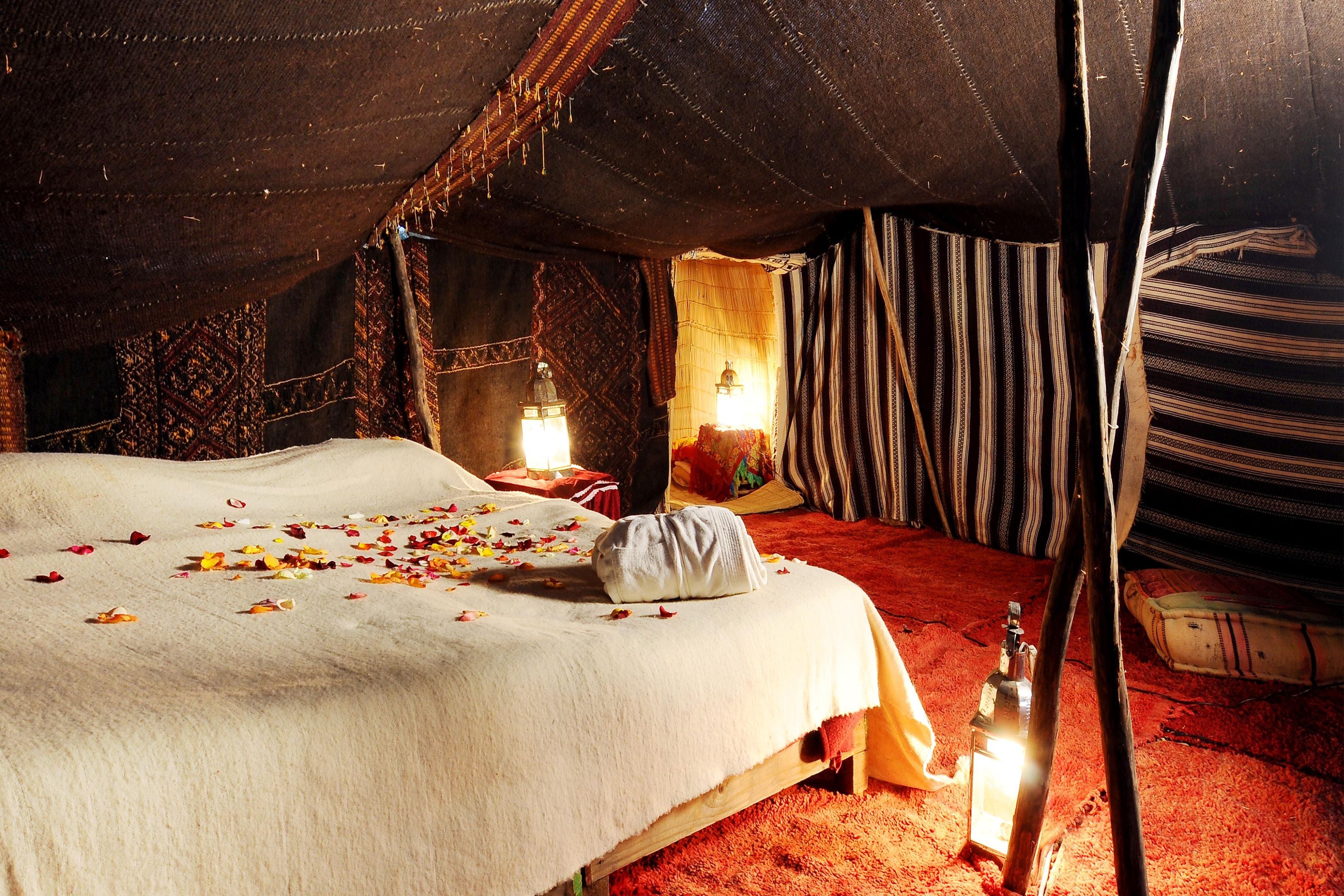
The setup is the first half of the magasm. Block out a real window of time, at least 45 minutes and ideally more. Warm the room, because cold defeats relaxation before it begins. Choose a single oil and warm it between your hands rather than applying it cold. Dim the lights or use a candle. Put both phones in another room entirely. If condoms may be part of the night, use a water-based or silicone-based lubricant for the sex itself, since most body oils break latex.
Moment Two
The Opening, Start Where The Body Holds The Week
Begin where tension lives, not where pleasure lives. Shoulders, neck, the long muscles of the back, the places where the week has been quietly accumulating. Use long, slow strokes that move with the breath, not the quick rubs of obligation. The first five minutes are not about technique at all. They are about giving the receiving partner's body permission to slow down. Until the breath lengthens, nothing else matters.
Moment Three
The Build, Touch That Asks
Once the breath has slowed, move outward. Arms, hands, legs, feet. Vary the pressure, alternate firm with feather-light, watch what makes the body sigh and stay there a little longer. Bring quiet communication in, a whispered "softer or firmer," without breaking the spell. The genitals are deliberately not the destination yet. That longing is doing its work.
Moment Four
The Transition, Let It Become More
This is where most couples falter, either by announcing it or by rushing past it. Don't. The moment when the massage wants to become something more, both partners feel it. Just let the touch travel. Inner thighs, lower abdomen, chest. The geography changes. The patience does not. The transition is led by the receiving partner's body, not by the giving partner's schedule.
Some magasms end in orgasm through touch alone. Some end in penetrative sex. Some end in two bodies falling asleep, half-undressed, completely at peace. None of these is a failure version of any other. The mistake is treating orgasm as the proof and everything else as the warm-up. The magasm is the whole arc. The last thirty seconds, whatever form they take, are just the punctuation.
If you start with the ending in mind
If you begin a magasm chasing the orgasm, you have already missed it. The body senses when it is being managed toward a finish line, and it does the one thing that ruins everything. It tenses. The slower truth is that magasms arrive most reliably when no one is reaching for them. Set up the ritual. Be present in the touch. Let the rest happen.
An Idea India Had Two Thousand Years Ago
This is not a new idea, only a forgotten one. The Kamasutra spent significant attention on what it called sparśa, touch, treating it as one of the most powerful of the senses and a foundational language of intimacy. The Ayurvedic ritual of abhyanga, daily oil massage, was prescribed not as a treat but as basic care, often performed between partners as part of ordinary life. Neither tradition saw massage as a means to anything else. It was complete in itself, with sex as a possible natural continuation rather than the proof that the touch worked. Two thousand years ago, Indian medicine and intimacy had already figured out what we needed to coin a new word to recover.
Touch was never meant to be a means to anything. It was always the thing itself.
The magasm is not really a technique. It is a different kind of attention, brought to a body you have probably touched a thousand times without ever really seeing. What ends in sex, what ends in sleep, what ends in tears or laughter or both, none of these is the magasm. The magasm was already happening, in the way two people put their hands on the person they love and let themselves both fall toward whatever wanted to happen next.
Read Next
The Presence Problem
How To Celebrate Intimacy At Home →
The Presence Problem
How Touch Rebuilds Intimacy And Connection →
The Presence Problem
The Four Types Of Intimacy →
The Presence Problem
How To Make Sex Feel More Romantic →
Join the Pillowta community
